
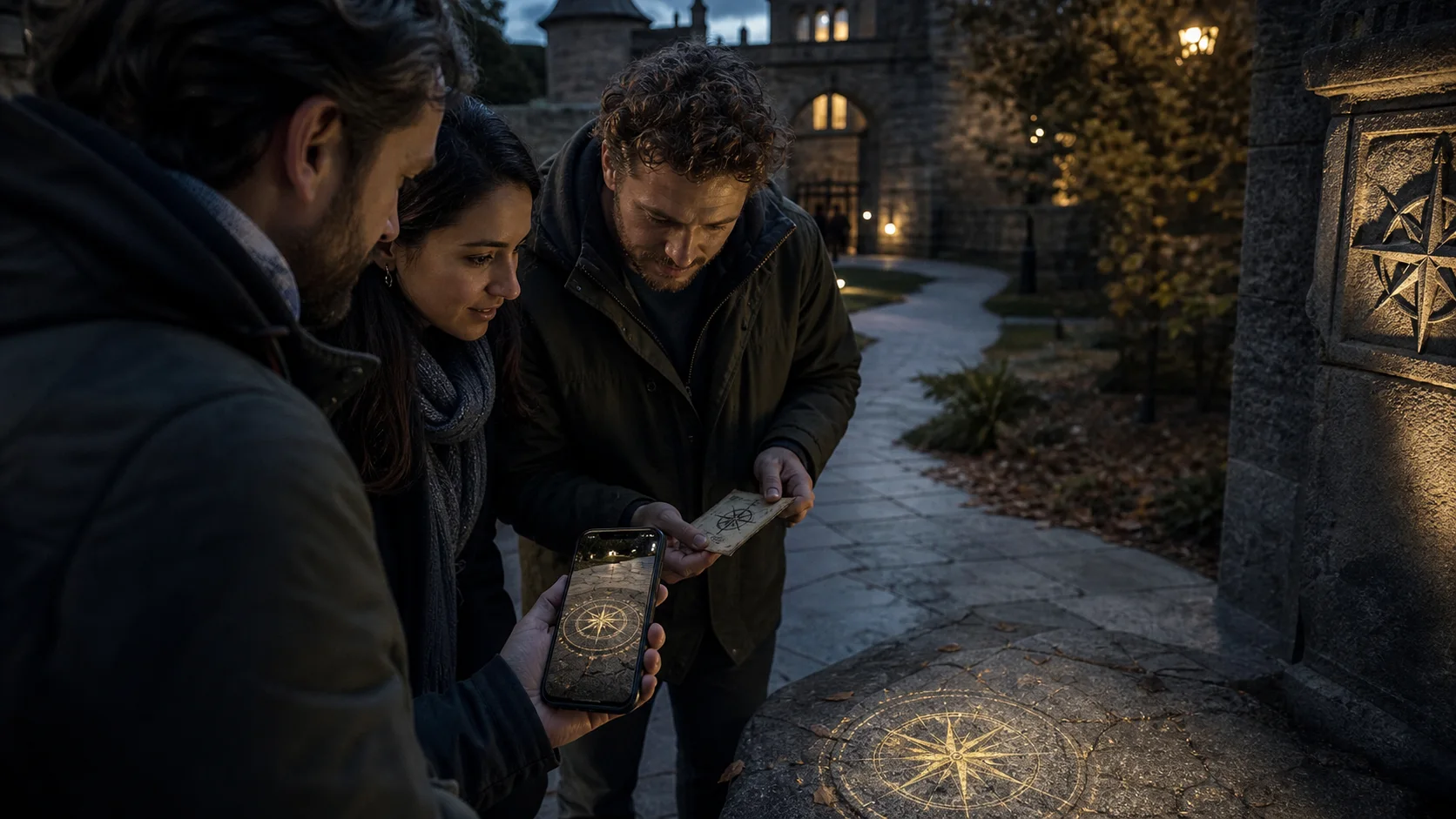
An augmented reality treasure hunt is a puzzle adventure built around a story and played through a phone. Digital objects, characters, and clues appear within the player's view of a real room or outdoor location, creating an experience that sits somewhere between a treasure hunt, an escape game, and an interactive story.
The appeal is not simply that a 3D object can appear on a screen. Good AR treasure hunts use that object as evidence. Players may need to inspect it, connect it with an earlier detail, decode what it reveals, or decide where it points next. The technology provides the scene, but observation and reasoning drive the experience.
The basic structure
Most AR treasure hunts are built around a clear mission. Something has been lost, hidden, interrupted, or left unexplained. The opening gives players enough context to begin investigating without telling them what each detail means.
The phone then becomes a way to examine the game world. An AR scene may contain a character, document, mechanism, symbol, or object that could not exist in the physical location. Players inspect what appears, compare observations, and solve a challenge. A correct answer advances the story and changes what the group knows.
This creates a useful rhythm: discovery, interpretation, solution, consequence. The strongest experiences make those parts feel connected. A puzzle does not appear merely to delay progress. It reveals something about the mystery or gives the group access to the next part of it.
- Real setting
- A room, street, park, or landmark remains part of the experience.
- Digital scene
- The phone reveals objects and story elements that are not physically present.
- Connected puzzles
- Each solution develops the story instead of completing an unrelated task.
What augmented reality contributes
AR gives designers a way to place detailed scenes inside ordinary spaces without constructing a permanent physical set. A living room can hold a strange machine. A quiet square can become the site of an investigation. A digital character can deliver information at the exact moment the group reaches a new stage.
It also changes how players examine clues. A digital object can be viewed from different angles, transformed, opened, or combined with information found elsewhere. Sound and animation can direct attention without spelling out the answer. The surrounding location can provide context, while the app controls the order in which discoveries become available.
None of this automatically makes a game interesting. AR is useful when it supports a clue, mood, or story moment that would be difficult to create another way. If the digital content has no relationship to what players are trying to understand, it becomes decoration.
How the format compares with other activities
Traditional treasure hunts
A traditional treasure hunt leads players through physical notes, objects, or hiding places. An AR version can use the same chain of discovery while replacing some physical materials with digital scenes. This makes it possible to create more elaborate objects and effects without leaving props in public or rebuilding a room after every game.
Scavenger hunts
Scavenger hunts usually ask players to find or photograph a list of separate things. An AR treasure hunt is more likely to follow one connected sequence. The answer to one clue changes what happens next, and the final discovery resolves a larger mission.
Geocaching
Geocaching is organized around coordinates and physical caches placed by members of its community. An outdoor AR hunt may also connect play with a real location, but it does not normally depend on finding a physical container. The reward is progress through the digital story.
Escape rooms
Escape rooms use a specially designed physical environment, usually within a fixed booking period. AR treasure hunts can offer a similar mix of clues and story without requiring a dedicated room. Depending on the product, they may work in a suitable indoor area or at a published outdoor location.
What makes an AR treasure hunt worth playing?
The difference between a convincing adventure and a collection of effects comes down to design. The real place, digital scene, puzzle, and story should support one another.
- A clear reason to investigate. Players should understand the central question even when the answer remains uncertain.
- Readable digital scenes. Important details need to be discoverable without reducing every challenge to a highlighted button.
- Fair puzzles. The solution should come from information the game has provided, not from guessing what the designer happened to be thinking.
- Useful feedback. Players need to know whether an interaction worked, an answer was accepted, or the scene has changed.
- A meaningful payoff. Solving a challenge should reveal information, alter the situation, or bring the group closer to the central mystery.
Group visibility matters as well. Only one person may be holding the phone, but everyone should have access to the important information. Reading text aloud, sharing observations, and rotating control keeps the experience social.
Indoor and outdoor play
Indoor AR treasure hunts offer a controlled setting and do not depend on travel or weather. They still require an appropriate clear area, enough light for the camera, and awareness of furniture, cords, stairs, pets, and other people using the room.
Outdoor experiences can make a real place part of the fiction. Streets, buildings, parks, and landmarks add atmosphere that a generic room cannot reproduce. They also introduce ordinary practical concerns such as weather, traffic, closures, terrain, crowds, and daylight.
The digital layer never overrides the physical setting. Players should stop before concentrating on the screen, follow posted rules, remain outside private or restricted property, and change plans when conditions are not suitable.
Where HuntAR fits
HuntAR creates AR treasure hunts built around stories, connected clues, digital scenes, and mystery. Indoor Mode allows a hunt to be placed in a suitable indoor space. Outdoor play is available at locations currently published by HuntAR.
The Hollow North shows the type of experience this format can support. Its premise follows the unfinished work of a folklorist and the disappearance of a boy named Elias. Players do not simply complete a series of abstract puzzles. They investigate what was left behind and uncover the story through play.
Current hunt availability, outdoor locations, price, and device requirements should always be checked on the official HuntAR pages and App Store listing before making plans.
What to check before choosing a hunt
Device compatibility is the obvious starting point, but it is not the only one. Consider how much movement the experience requires, whether the theme suits the group, and whether everyone can participate comfortably. For outdoor play, check the published location and current conditions. For indoor play, confirm that the available space matches the game's setup instructions.
It is also worth reviewing the app's camera, location, and privacy information. These permissions may be necessary for the experience, but they should still be understood rather than accepted without context.
A puzzle game connected to place
An AR treasure hunt is most effective when the technology disappears behind the investigation. Players remember the clue they nearly missed, the theory that turned out to be wrong, and the moment several details finally made sense. The phone makes the scene possible. The shared act of solving it is what makes the experience work.